
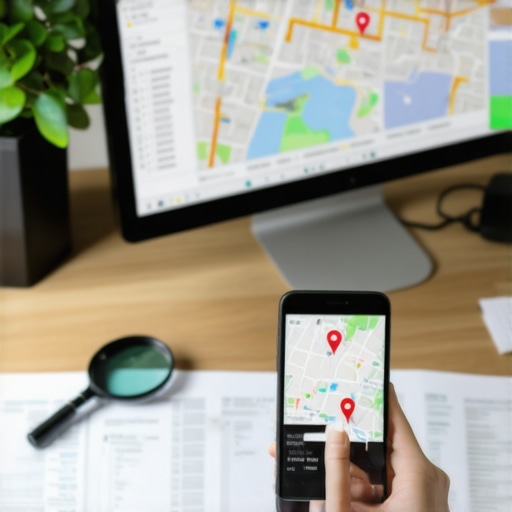
How to Fix the Google Maps Ranking Error Costing You Leads
Imagine this: You have spent years building your business. You have a 4.9-star rating with dozens of glowing reviews. Your service is impeccable, and your customers love you. Yet, when you search for your services in your own city, your business is nowhere to be found in the top three results – the coveted “Local Map Pack.” Instead, you are buried on page two or three, effectively invisible to 90% of potential customers.
This isn’t just bad luck. This is what I call the “Ranking Error.” It is a technical and strategic misalignment between your Google Business Profile (GBP) and the Google Maps algorithm. In today’s digital landscape, being outside the top 3 on Google Maps is a “lead bleed” that costs small businesses thousands of dollars in lost revenue every single month. If you aren’t in the Map Pack, you don’t exist.
My name is Kevin Pauls. As a Local SEO Consultant and Google Business Profile Product Expert, I have spent my career diagnosing why high-quality businesses fail to appear in search results. I help businesses and agencies dominate Google Search by fixing the underlying errors that trigger algorithmic suppression. If you want to rank higher on google maps and master google business profile seo, you need to stop guessing and start diagnosing.
Section 1: Diagnosing the “Ghost Listing” Syndrome
The first step in fixing your ranking error is understanding how Google actually decides who gets the top spots. The Google Maps algorithm is built on three specific pillars: Proximity, Relevance, and Prominence. Most business owners suffer from “Ghost Listing” syndrome because they focus entirely on proximity, which is a fixed variable you cannot change without moving your office.
The “error” most businesses make is neglecting the other two pillars. Proximity is simply how close you are to the searcher. Relevance is how well your profile matches the searcher’s intent. Prominence is how well-known your business is across the web. When these are out of sync, Google views your listing as a “ghost” – it exists, but it has no substance in the eyes of the algorithm.
Recent research from the local SEO community on platforms like Reddit has highlighted a disturbing trend: businesses are dropping from positions 3 or 4 down to 13 or 20 overnight. This often happens because of unoptimized service areas or “filtering.” If Google cannot verify exactly where you provide services or if your profile lacks specific relevance signals, it will filter you out in favor of a competitor who may be further away but has a “louder” digital presence. This is why Why Buying Cheap Google Maps SEO Packages is a Huge Mistake; those packages rarely address these deep-seated local seo ranking factors.
To fix this, you must shift your focus from “being near the customer” to “being the most relevant and prominent answer to the customer’s problem.” This requires a shift in how you handle your google map pack ranking factors, moving away from basic setup toward aggressive optimization.
Section 2: The Infrastructure Error: NAP Consistency & Citations
Every dominant Google Maps presence is built on a foundation of solid “infrastructure.” As my colleague and expert Rashid Rehman often points out, if your digital foundation is cracked, no amount of posting or reviewing will save you. The most common infrastructure error is inconsistent NAP data: Name, Address, and Phone number.
Google is a massive verification engine. If your business name is “The Magic Plumber” on Google, but “Magic Plumbing LLC” on Yelp, and “The Magic Plumber Inc.” on your website, Google sees three different entities. This lack of confidence leads to a ranking drop. The fix is a rigorous cleanup of your citations – the mentions of your business across the web.
Data shows that domain name transfers, website redesigns, or physical address updates are the most common triggers for a sudden ranking collapse. If you update your address on your website but forget to update it on twenty other directories, Google’s trust in your location data plummets. I recommend using professional local seo tools to audit your citations and identify where your data is fragmented. This is especially critical for niche service providers, as detailed in The NAP Consistency Error That Makes Your Sleight of Hand Services Invisible.
A clean NAP profile tells Google: “This business is real, it is where it says it is, and it is reachable.” Without this certainty, you will never achieve consistent google business profile optimization.
Section 3: Category Alignment & Service-Area Optimization
Choosing the wrong primary category is a fatal error that can kill your rankings before you even begin. Your primary category is the strongest signal you send to Google about what you do. If you are a personal injury lawyer but you set your primary category to “Legal Services,” you are competing in a much broader, more difficult pool than if you chose “Personal Injury Attorney.”
The fix is to align your primary and secondary google business profile categories with high-intent search terms. You should look at the top three competitors in your city and see what categories they are using. Often, adding a specific secondary category like “Emergency Plumber” or “Wedding Magician” can bridge the gap between a general search and a specific lead.
For businesses that don’t have a physical storefront where customers visit (Service Area Businesses or SABs), the error is often “over-reaching.” Many owners select a massive service area, thinking it will help them rank google business profile across a whole state. In reality, this dilutes your relevance. Google prefers to show businesses that are local to the searcher. By tightening your service area to the specific zip codes you actually serve, you increase your relevance in those specific spots. This is a common hurdle for specialized clinics, as I discuss in The Med Spa Local SEO Fix: Why Your Clinic is Invisible Online.
Section 4: The Engagement Gap: Reviews and GBP Posts
Google prioritizes “active” profiles. A static profile is a ranking error. If you haven’t updated your profile, posted a photo, or responded to a review in three months, Google assumes your business might be closed or stagnant. This creates an “Engagement Gap” that your competitors will exploit.
The fix is a dual-pronged google review strategy. First, you need a consistent flow of new reviews. A business with 100 reviews from two years ago is less relevant than a business with 20 reviews from the last month. Second, those reviews should ideally contain keywords. When a customer writes, “The best emergency plumber in Chicago,” it reinforces your relevance for that specific search term. You can encourage this by asking customers to mention the specific service they received.
Furthermore, you must use GBP Posts. These are like mini-social media updates that live on your profile. They signal life to the algorithm. In one case study, a client of mine saw an organic ranking boost that led to 74+ calls in 30 days without spending a single dollar on ads, simply by increasing post frequency and review response speed. To track these leads effectively, I suggest using a google maps ranking booster to see which posts are actually driving keyword movement. For more ideas, check out these 5 Google Business Profile Engagement Tactics.
Section 5: Technical Recovery: Suspensions & Map Pack Dominance
Sometimes, the ranking error isn’t about optimization – it’s about survival. If your profile is suspended, you are effectively erased. Suspensions often happen due to “suspicious activity,” which can be as simple as changing your business name too many times or using a virtual office address that Google has flagged. Fix google business profile suspension issues by providing “unassailable proof” of your business: utility bills, business licenses, and photos of your branded vehicle or signage.
Another technical issue is the “Marker Overlap.” This occurs when your business is located in a building with dozens of other businesses (like a skyscraper or a co-working space). Google’s algorithm sometimes “covers up” one marker with another to keep the map clean. To fix this, you need a “prominence boost.” You must out-rank the other businesses in your building on a technical level so that Google chooses your marker to be the one visible at higher zoom levels.
Using a professional google maps rank tracker is essential here. You need to see a “grid” of your rankings across the city, not just a single point. This allows you to see where your “ranking bubble” ends and where you need to apply more pressure. If you are facing a sudden disappearance, follow the steps in The Fast Move to Fix a Suspended Google Business Profile. Using a gmb ranking service can also help navigate these complex technical recoveries.
Section 6: The 2026 Hyperlocal Content Strategy
As we move toward 2026, “Intent Alignment” is becoming the new gold standard for google maps ranking service providers. Google is getting better at understanding the relationship between your website and your GBP. To dominate, you must move beyond the profile and optimize your website for hyperlocal seo.
This means creating geo-targeted pages for every suburb or neighborhood you serve. These pages shouldn’t just be “keyword stuffing” zones; they should contain local information, local landmarks, and local schema markup. Schema is a piece of code that helps search engines understand the context of your data. By telling Google exactly where your service area boundaries are through code, you remove the guesswork for the algorithm.
The goal is to create a “Local Authority Loop” where your website proves your relevance, and your GBP proves your prominence. This is the core of The Hyperlocal Content Strategy: How to Outrank Big Brands in Your Own Backyard.
Conclusion: Your Google Maps Checklist
Ranking on Google Maps isn’t magic; it is a series of technical and strategic alignments. To stop the lead bleed, you must:
- Audit your NAP consistency across the web.
- Ensure your Primary Category is perfectly aligned with your most profitable service.
- Implement a daily or weekly engagement strategy for reviews and posts.
- Use technical tools to monitor your ranking grid and identify “dead zones.”
If you are tired of being invisible while your competitors take your calls, it’s time to act. Audit your profile today or learn How to Hire a Google Business Profile Expert Who Actually Gets Results to secure your spot in the top 3.