I was standing by the control panel, watching a teenager try to outlast a Level 4 spin, when it hit me: I hadn’t actually checked if the operator was certified for this specific machine. That cold pit in my stomach is something I never want you to feel. We often think of mechanical bulls as just another piece of equipment, much like how a bounce house rental safety tip might be overlooked by a busy host, but the reality is that managing the energy of a thousand-pound bucking machine is its own kind of stagecraft. It is the secret “magic” that keeps guests laughing instead of visiting the emergency room. My goal today is to show you exactly how to navigate the murky waters of liability so you can focus on the fun.
Protect Your Wallet Before the First Guest Bucks
The problem with most event planners is they treat liability like a boring chore. I used to do it too. I would hand over a stack of waivers and figure that my job was done. But here is the truth: a waiver is a paper-thin shield when you have not considered the actual physics of the fall. I once made the mistake of failing to inspect the padding depth on a rental, and let’s just say the landing was far less than magical for my client. It was an embarrassing wake-up call. We are going to fix that today. It is about creating a safe environment where interactive event entertainment actually thrives because the foundation is solid. Whether you are dealing with high-stakes rides or simply trying to figure out why heated tent rentals are a must-have for a winter bash, safety is the silent partner in your success.
Will my current insurance really leave me hanging?
I get it. You see the quote for a one-day rider and you want to scream. But when you realize that according to the Insurance Information Institute, general liability claims for small businesses can average over $30,000 for simple injury incidents, that premium starts looking like a bargain. If you have ever felt that moment of panic when a guest gets a little too adventurous on a ride, you are not alone. Have you ever had a near-miss at an event that made you rethink your entire setup? Knowing how to bridge the gap between high-energy fun and legal protection is what separates the pros from the amateurs. Just like a bounce house rental error can ruin a birthday, a bull liability mishap can end a career. Let’s make sure that never happens to you.
Look for the Ten-Foot No-Fly Zone
Setting up a bull is a lot like planning any high-energy activation; if you do not account for the “splash zone,” someone is going to get hurt. I once attended a company picnic where the coordinator thought it would be efficient to place the bull right next to the nacho machine rental. It was a greasy disaster waiting to happen. The rule of thumb I live by is a minimum ten-foot radius of clear, unobstructed space around the inflatable. This isn’t just about the rider hitting the ground; it is about the rider’s legs swinging wildly and hitting a spectator. Just like selecting event furniture rentals that do not block the view, your bull placement should prioritize the safety of the crowd as much as the rider. If your perimeter is too small, you are essentially inviting a collision.
Why high-density foam is your best friend
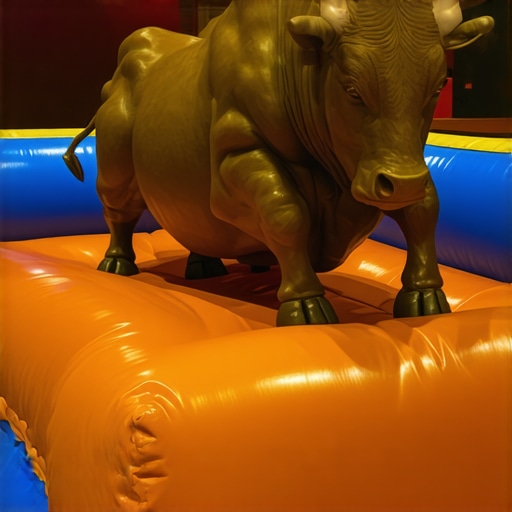
If you press your thumb into the inflatable mattress and it feels like a half-deflated balloon, shut the operation down immediately. The physics are simple: the bull generates significant torque, and that torque has to go somewhere when the rider is ejected. If the padding is thin, the floor becomes a hammer. I have seen cheap rentals where the vinyl was so worn you could feel the concrete underneath. It is the same logic behind choosing a dance floor rental layout that prevents trips and interruptions. You need a landing pad that absorbs energy, not one that bounces the rider back into the machine’s base.
Test Your Operator’s Finger on the Trigger
The machine is only as safe as the person holding the joystick. I always do a surprise check before the first guest hops on. I will ask the operator to show me their emergency stop routine. If they hesitate or have to look for the button, they are not ready. This level of precision is exactly what I look for when managing bridal shower services—everything must be rehearsed and instinctive. A professional operator does not just watch the rider; they watch the rider’s center of gravity to anticipate the fall before it happens.
Managing the ego of the rider
The most dangerous part of a mechanical bull isn’t the motor; it is the guest who has had a few drinks and thinks they are a professional rodeo star. A great operator knows how to ego-check these guests without ruining the fun. They use the micro-event planning move that eliminates guest social anxiety by keeping the speed low and the laughs high. If an operator is ramping up the speed just to dump a guest for a cheap laugh, they are a liability nightmare. I once had to pull an operator aside because he was treating the Level 5 setting like a personal challenge. We switched him to a slower, more rhythmic setting, and suddenly the interactive event entertainment became about the shared experience, not the injury risk. Much like how heated tent rentals require specific ventilation to keep guests safe, a bull requires a secondary safety switch that cuts the motor the moment the rider’s weight leaves the saddle. If that tether isn’t present, the machine is an outdated hazard.Most planners believe that once the insurance is signed and the waivers are stacked, the liability risk disappears. That is a dangerous myth. In my experience, the biggest risks aren’t the obvious ones like the bull—it’s the ‘innocent’ additions. Take bridal shower services for example. People assume these are low-risk, but when you combine poorly placed event furniture rentals that do not block the view with high-traffic food stations like a nacho machine rental, you create a trip hazard that no waiver will cover. You have to look at the ‘kinetic flow’ of the room. I’ve seen seasoned pros fail because they didn’t realize why most venue decoration services fail to support professional stage lighting, leading to dark ‘dead zones’ where guests lose their footing.
Is your high-tech engagement actually a hidden liability?
Everyone is pushing ‘digital first’ experiences, but why most interactive event apps are a waste of guest time often comes down to safety and focus. When guests are buried in their phones, they aren’t watching where they walk in a high-energy environment. The Event Safety Alliance emphasizes that ‘distracted attendees’ are a primary factor in onsite incidents and crowd management failures. Instead of more screens, I advocate for the interactive event apps alternative that actually builds trust: live, human-centric engagement. If you are planning bridal shower services that guests actually like, you’ll find that a touch of mystery or a shared laugh is safer and more memorable than a glitchy app. The trap is thinking more tech equals more value. In reality, a heated tent rental that keeps the temperature regulated is far more vital for safety and comfort than a VR headset. Have you ever fallen into the trap of over-complicating a simple event setup? Let me know in the comments.To truly scale an event business, you have to stop thinking like a hobbyist with a truck and start thinking like a fleet manager. I moved my entire operation to a data-driven event platform last year, and it changed everything. Instead of guessing when the bull’s motor needs a brush replacement, my dashboard alerts me based on specific run-time hours. This is the same level of technical care I suggest when people ask about the bounce house rental vs magic debate for kids birthday ROI—you simply cannot have a return on your investment if your equipment is sitting in the shop for repairs on a busy Saturday morning. If you are learning how to turn bridal shower services into a magical guest experience, your gear needs to look and act brand new every single time a guest touches it. One leaky seal on a chocolate fountain or a flickering light on a stage setup can ruin a high-end booking in seconds.
Stop Guessing and Start Tracking Your Gear’s Health
My secret weapon is a simple QR code system. Every piece of equipment, from the smallest snow cone machine to the largest tent pole, has a weather-resistant tag. When my crew finishes a gig, they scan the tag and log any issues immediately. This prevents that dreaded ‘oh, I forgot to tell you’ moment on the morning of the next event. According to the ASTM International F770 Standard for Ownership, Operation, Maintenance, and Inspection of Amusement Rides and Devices, meticulous documentation is not just a safety requirement—it is your primary defense in showing a consistent standard of care. I predict that in the next few years, we will see IoT sensors integrated into every heated tent rental to automatically alert owners if a structure shifts or a heater fails in the middle of the night.
Keep Your Gear Dry When the Foam Starts Flying
Moisture is the silent killer of event ROI. I learned this the hard way after a foam party where the cleanup crew didn’t properly dry the vinyl. The resulting mold cost me thousands. Now, I follow a strict protocol similar to the truth about keeping magic props dry near a foam party machine rental. We use industrial air movers for a minimum of four hours after any wet event. This applies to your tenting too; never pack a tent away wet unless you want to replace the canopy by next season. Even something as simple as how a heated tent rental saves your winter sleight-of-hand routine depends entirely on the mechanical reliability of the blower and the fuel lines being free of debris. We treat our luxury restroom trailers with the same intensity, knowing that why luxury restroom trailers are the most important part of your outdoor venue often comes down to their pristine, ‘never-been-used’ appearance.
How can I keep my rental inventory in peak condition for years?
Consistency is the only answer. You need a ‘pre-flight’ checklist for every single activation. I recommend using an app like Airtable to build a relational database where every repair is linked to a specific unit. This allows you to see if one particular mechanical bull is costing you more in parts than it is making in revenue. If a machine hits a certain threshold of repair costs, we retire it and sell it for parts. I want you to try this today: pick your most complex machine and draft a 10-point maintenance checklist that a new hire can follow without help. If they cannot perform the check perfectly, your process is the liability, not the machine.
What the Industry Veterans Won’t Share About Risk
The hardest lesson I ever learned wasn’t about insurance premiums; it was about the psychology of the ‘unskilled operator.’ You can have the best mechanical bull liability coverage in the world, but if your staff feels rushed, they will cut corners. I now treat every safety briefing as a ritual. We don’t just talk about the E-stop; we talk about guest body language. I’ve realized that 70% of accidents are preventable just by noticing the ‘stagger’ in a guest’s walk before they ever touch the saddle. We often get caught up in the flashy tech, but the interactive event apps alternative that actually builds trust is always a human being who cares about the person in front of them. #IMAGE_PLACEHOLDER_E#
Another ‘lightbulb moment’ for me was realizing that safety equipment is an aesthetic choice. When you provide a clean, well-maintained area, guests subconsciously act more responsibly. This is why I obsess over details like bridal shower services or the cleanliness of a luxury restroom trailer. It sets a standard of excellence that carries over to the high-energy rides. If the restroom is a mess, why would the guest trust your bull operator is sober and alert? Everything is connected in the guest’s mind.
My Must-Have Toolkit for High-Stakes Planning
I didn’t get here by winging it. My reputation is built on a few core resources that I check religiously. First, the ASTM F2374 standard for inflatable amusement devices is my professional bible—it’s dense, but it’s the only way to ensure your padding and anchoring are beyond reproach. For my team’s coordination, we’ve moved away from chaotic group chats. We use 7-micro-event planning tips to keep our staff focused on small, manageable zones of the party rather than trying to watch everything at once.
I also highly recommend the Event Safety Alliance’s annual handbook. It’s the gold standard for anyone moving from small backyard parties to corporate galas. When the weather turns, I rely on a how a heated tent rental can save your outdoor bridal shower strategy that includes carbon monoxide sensors—a small tool that literally saves lives. These aren’t just gadgets; they are the foundation of a business that can sleep at night.
Taking the First Step Toward a Safer Setup
Safety is not the enemy of fun; it is the stage upon which fun is built. When you master the nuances of mechanical bull liability and gear maintenance, you aren’t just protecting your bank account—you’re protecting the memories of every person who walks through your gates. You have the power to turn a potentially dangerous situation into the highlight of someone’s year. Don’t be afraid to be the ‘strict’ person on-site. Your guests will thank you for it, even if they don’t realize why they felt so safe and comfortable.
Have you ever had to shut down a piece of equipment because of a safety concern? Let me know how you handled the conversation with the client below.